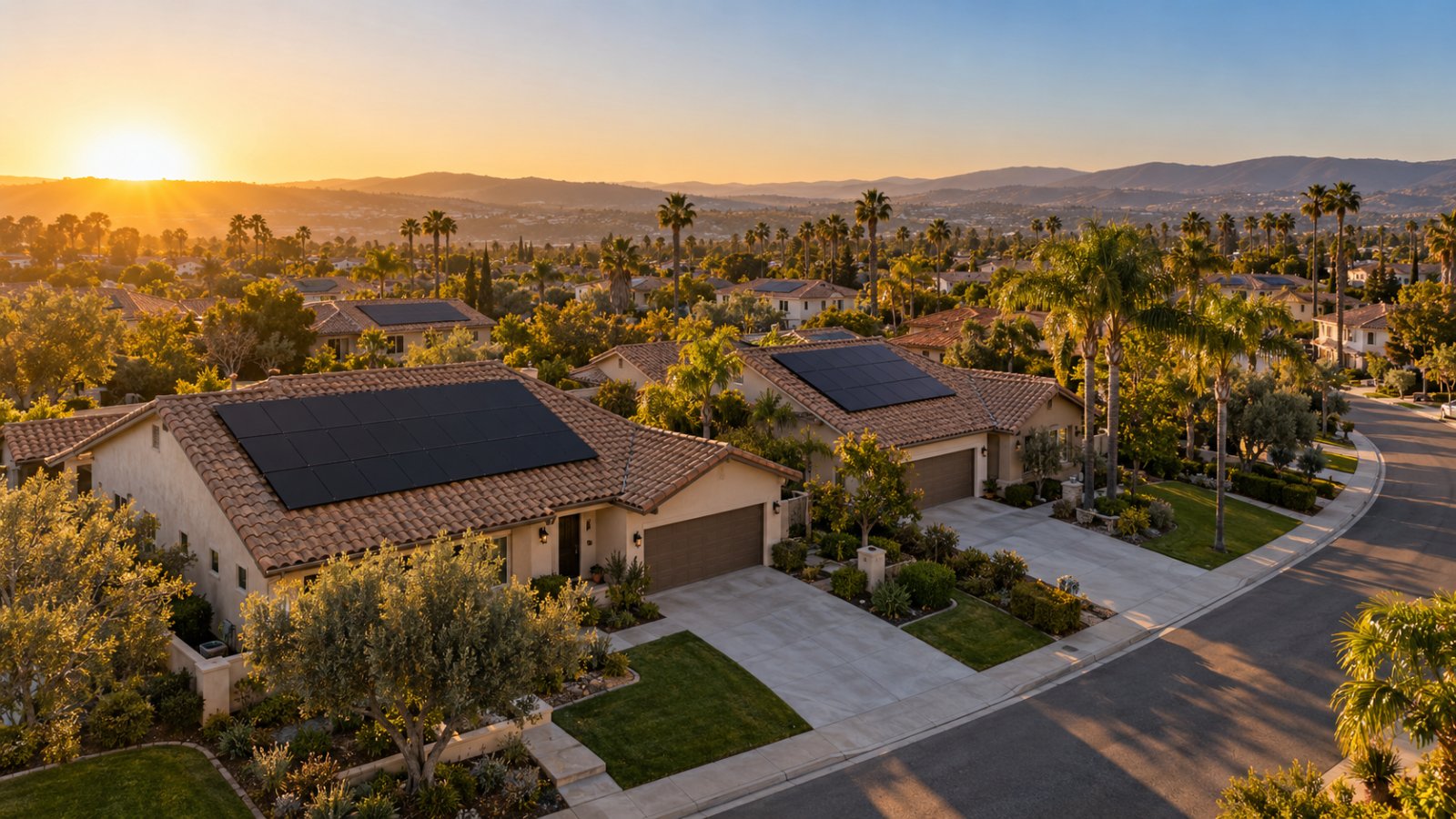
How California solar economics have shifted since NEM 3.0 and the end of the federal tax credit for purchased systems. What SGIP still covers, when solar plus battery still pencils out, and how to read a quote when the math is more complicated than it used to be.
California solar in 2026 pencils out very differently than it did in 2024. NEM 3.0 killed most of the export-credit value, the federal tax credit ended for purchased systems, and SGIP still pays a real share of battery cost. A well-designed solar plus battery system can still make economic sense for most California homeowners on tiered TOU rates. Solar-only rarely does anymore.
Most California solar shoppers are working with 2020-era mental math. That math is broken now. Three specific changes reshuffled the deck between 2023 and 2026, and if you don't recalibrate, you'll either dismiss solar when it still makes sense for you or overpay for a system that no longer does.
Here's what actually determines whether solar is worth it in California in 2026.
What NEM 3.0 actually did to solar economics
California switched from NEM 2.0 to NEM 3.0 in April 2023, and it changed the payback math more than the marketing tried to admit. Under the old NEM 2.0 rules, exported solar power was credited at roughly the same retail rate you paid to buy power from the utility. Solar sent to the grid at 2 pm effectively saved you the same amount as the power you bought at 7 pm.
NEM 3.0 broke that. Exported solar now pays somewhere between 5 and 8 cents per kWh (the exact number varies by hour and season), while imported evening power costs 40 to 55 cents on TOU rates. That's roughly an 80% haircut on the value of every kWh you send back to the grid.
The practical result: solar-only systems in California don't pencil out anymore for most households. Not because solar generates less power, but because the value of the power it sends to the grid collapsed. Same panels, same production, dramatically worse economics.
The workaround is a battery. A battery stores midday solar for evening self-consumption, which captures the full retail-rate value instead of the exported nickel. Under NEM 3.0, a battery is often what makes the system economically viable at all.
The federal tax credit and what actually replaced it
The 30% federal Residential Clean Energy Credit expired December 31, 2025 for purchased systems. If you install solar today and pay cash or finance it with a loan, you don't get the 30% credit. That's a real change and it worsens payback economics by 3 to 5 years for a lot of cash-purchase math.
There's a workaround that most quote-comparison sites don't explain clearly. The commercial version of the credit (48E) is still active through 2027. That credit applies to systems owned by companies, not homeowners, which means a solar lease or PPA, where the leasing company owns the system on your roof, still captures the 30% credit and passes some or all of it through to you as lower monthly payments.
Practically: if you're financing solar through a lease or PPA in 2026, the deal usually reflects that pass-through. If you're financing through cash or a loan, you're paying the full ticket. The math tilts toward lease and PPA in California for the first time in a decade.
Where SGIP fits in
California's Self-Generation Incentive Program (SGIP) pays homeowners a rebate for installing a battery. The rebate is per kWh of battery capacity and scales down as budget tiers fill up, which means the exact rate keeps stepping lower. Current SGIP tier rates are in the $150 to $250 per kWh range for standard residential customers, and higher for medically vulnerable households or those in wildfire-prone areas.
For a typical residential battery (10-15 kWh), that's usually $1,500 to $3,000 back. Not life-changing on its own, but combined with battery-specific installer incentives and the fact that a battery is what makes NEM 3.0 economics work at all, it's a meaningful piece.
SGIP applications are handled by the installer. Homeowners don't file directly. Ask any installer quoting you a battery whether SGIP is factored into the pricing you see. Some quote pre-SGIP prices, some quote post-SGIP prices. Comparing quotes without confirming this is one of the most common ways homeowners think they're comparing apples to apples when they're not.
What actually determines solar payback in California now
Six factors, in rough order of impact:
Your utility and rate schedule. SCE, SDG&E, and PG&E all have different tiered TOU rates. Households on the highest tiers save the most from solar. If your average monthly bill is under $120, solar payback is probably too long to make sense. Above $200, it usually still pencils out with a battery.
Roof orientation and shade. South-facing unobstructed roofs generate the most useful power. West-facing is a close second and increasingly recommended in California because it produces power in peak evening hours. Heavy shade kills systems fast.
Battery attachment. Solar-only in California in 2026 rarely pencils out. Solar plus battery usually does. If you're not adding a battery, the math likely doesn't work regardless of everything else.
Financing structure. Cash purchase: no 30% credit, longer payback, but you own the system outright. Loan: same, plus interest. Lease or PPA: shorter payback because of the commercial credit pass-through, but the leasing company owns the system. Prepaid lease combines some benefits of both.
Home load profile. If you use a lot of power in the evening (electric heating, EV charging, air conditioning), a battery captures more value. If your load is flat, less so.
Local rebates and utility programs. SGIP is the big one. Some utilities also offer battery-specific bill credits or demand-response payments. These stack.
When solar still pencils and when it doesn't
Solar plus battery usually pencils out if you're in California and:
- Monthly bill averages $150 or more
- Roof gets meaningful sun (south or west, minimal shade)
- Planning to stay in the home 8-10 or more years
- Willing to finance through lease or PPA if cash math doesn't work
Solar rarely pencils out if:
- Monthly bill is under $100
- Roof has significant shade
- Planning to sell within 3-5 years
- Solar-only, no battery interest
Battery-only sometimes pencils out for wildfire-prone areas with public safety power shutoffs, or for medically vulnerable households eligible for enhanced SGIP tiers. Not the volume case, but real for those specific situations.
How to compare quotes when the math is more complicated
The problem in 2026 California solar shopping is that the same house can get quotes from four different installers that look completely different: different system sizes, different battery sizes, different financing, different SGIP treatment, different pricing conventions.
Two questions to ask every installer quoting you:
1. Is the SGIP rebate baked into the price you're showing me, or will I see it as a separate credit later?
2. Under what financing structure does this price assume? Cash, loan, lease, or PPA?
Two things to compare across quotes:
1. Total 25-year system cost including projected utility bill savings, not just up-front price.
2. What you'd owe if you sold the home in year 5 or year 10. Some financing structures have transfer fees or buyout clauses that matter.
Solar Connect's quote flow generates quotes side by side using the same system size and financing assumptions across every installer, which removes most of this comparison work. Even without a marketplace, asking those questions of any installer will surface the actual comparable numbers.
Bottom line
California solar is not dead in 2026. It's just very different. NEM 3.0 killed solar-only economics for most households. The federal credit ending shifted the math from cash purchase toward lease and PPA. SGIP still pays for a share of the battery that makes the whole system economically viable.
If you have a moderate-to-high utility bill, a decent roof, and you're planning to stay in the home, solar plus battery still makes economic sense. If any of those three don't apply, the math is a lot tighter than it used to be. Get quotes, ask the two questions above, and compare 25-year costs rather than sticker prices.
Compare solar plus battery quotes from vetted California installers, side by side, at Solar Connect.