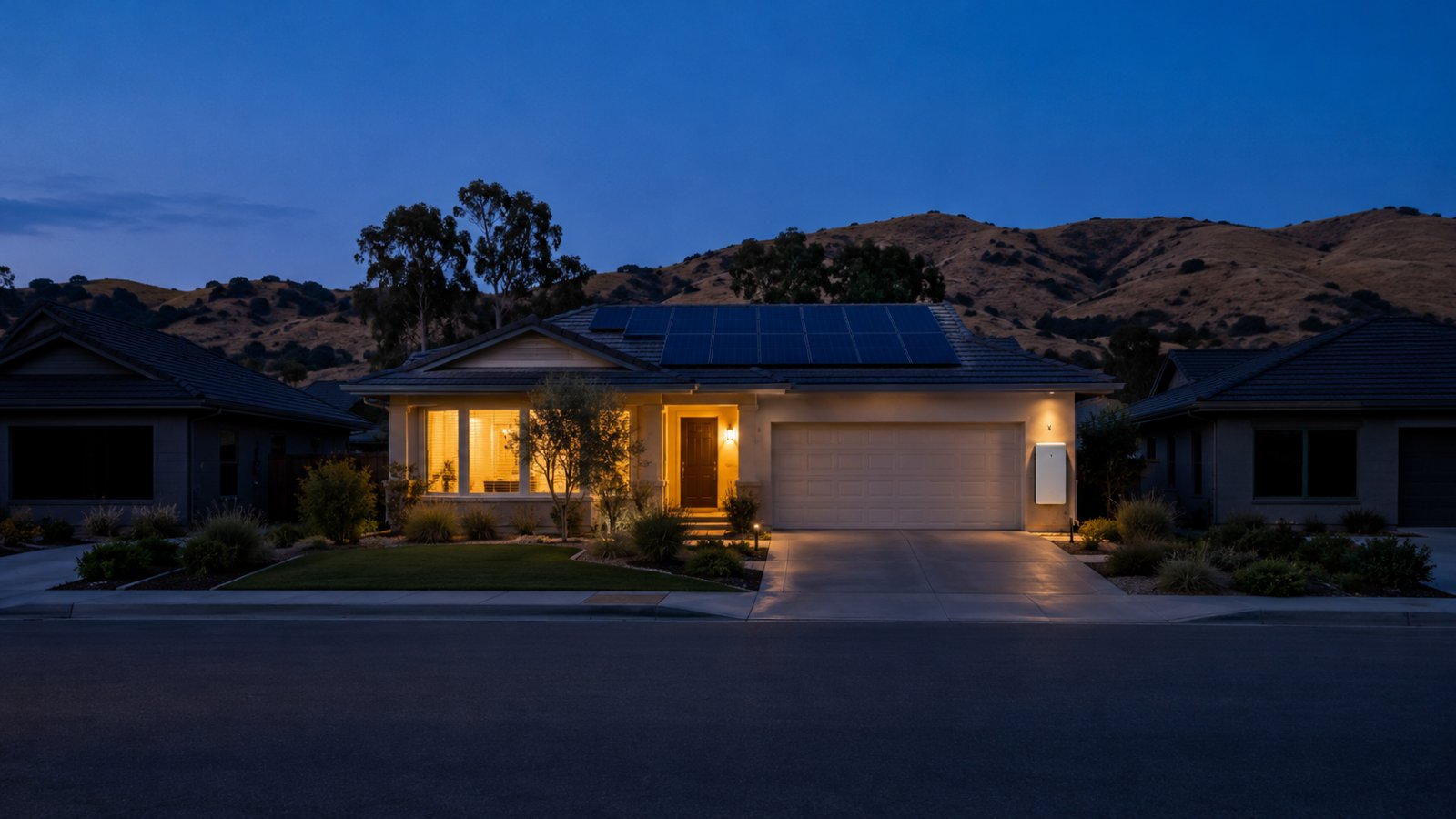
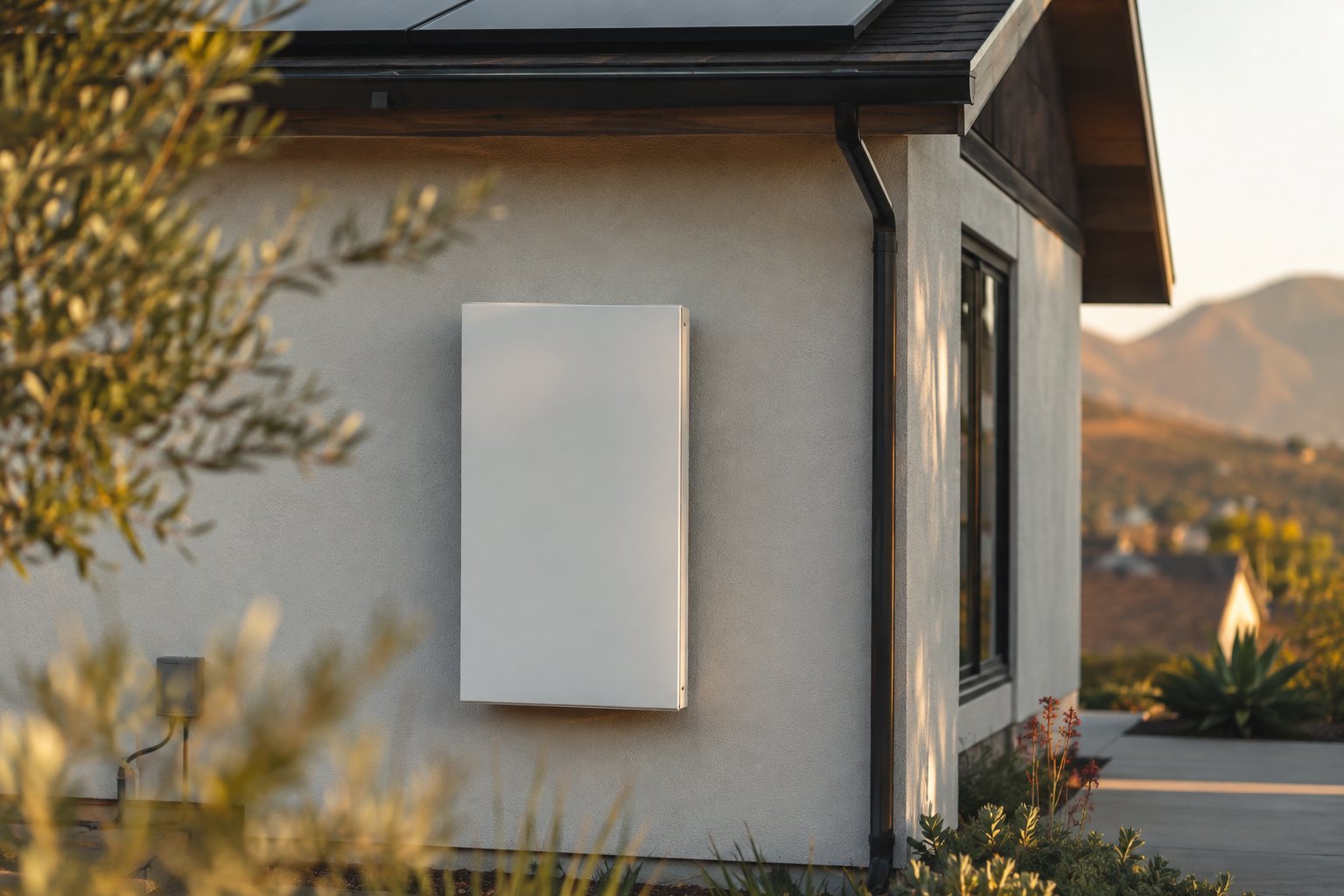
Grid-tied solar shuts off when the power goes out, by design. Here is why, what a battery actually changes, and how to tell from a quote what you'd get.
No. If you have ordinary rooftop solar and the grid goes down, your panels stop producing, even at noon on a cloudless day.
Most people find this out during an outage, standing in a dark kitchen under a roof covered in panels. It feels like a defect. It isn't. It's a safety requirement, and it has been one since long before you shopped for solar.
Grid-tied solar is required to shut itself off within a couple of seconds of losing the grid, so it can't push power into lines that utility crews are working on. A battery changes that, because the battery can disconnect your house from the grid and run it as its own small island. Without a battery, a standard solar system gives you nothing in an outage. Whether a quote includes real backup is usually visible in one or two line items, and it's worth checking before you compare prices.
Why your solar shuts off when the grid does
Your inverter is the box that turns the DC your panels make into the AC your house uses. It also watches the grid.
When the grid disappears, the inverter has to assume a line somewhere is down and someone may be working on it. A system that kept producing would backfeed that line and energize it from the customer end. That's the scenario the rule exists to prevent, and the industry term for it is anti-islanding. Every grid-tied inverter sold in the US is certified to do it.
So the shutoff isn't a failure. It's the inverter doing the one thing it is required to do.
A smaller consequence people don't expect: it also means you can't run an extension cord from the array to the fridge. There's no outlet to run it from. The panels are DC, the inverter is off, and the parts in between are not meant to be improvised with.
What a battery actually changes
A battery doesn't just store electricity. The useful part is the switching gear that comes with it.
In a backup-capable install, there's a device between your house and the utility meter that opens the moment the grid fails. Once that connection is open, your home is electrically separated from the grid. Nothing you produce can reach a line worker. At that point the inverter is allowed to turn back on, the battery carries the load, and your panels can charge the battery through the day.
That last part is the piece that matters most in a multi-day outage. A battery alone is a fixed amount of energy that runs down. A battery paired with solar refills every morning.
"Backup" does not always mean the whole house
This is where quotes diverge the most, and where the word does the least work.
Most residential backup setups are
partial. The installer moves a handful of circuits into a separate subpanel, often called a critical loads panel, and only those circuits stay alive. Typical picks: the refrigerator, a few outlets, internet equipment, some lights, maybe the furnace blower.
Whole-home backup keeps the main panel energized. It costs more, usually needs more battery capacity, and often needs load management hardware so the system can shed the air conditioner or the EV charger before it overloads itself.
Neither is wrong. But a quote that says "backup included" and a quote that says "whole-home backup" can be describing very different outcomes at the same price, and the cheaper one is not automatically the worse buy. It depends on what you actually need running.
How long any of it lasts comes down to capacity against draw. A battery backing up a fridge and a few lights behaves nothing like one trying to hold central AC through a July afternoon. We wrote a separate piece on how much battery you need, because that question deserves its own math.
The daytime-only exception, and why it's rare
A few inverters offer a limited backup outlet that works without any battery at all. When the grid is down and the sun is up, the inverter feeds a single dedicated circuit, often capped somewhere around 1,500 watts.
It's genuinely useful for a phone, a laptop, a router, a small fridge. It's also unpredictable. Output follows the sun, so a passing cloud drops it, and at sunset you have nothing. Very few homeowners buy a system for this feature. It's worth knowing the option exists, mostly so you recognize it on a spec sheet and don't mistake it for real backup.
Why Californians ask this question every October
Public Safety Power Shutoffs are the reason. When fire weather lines up with dry fuel and high wind, the utilities de-energize circuits on purpose, and the outages run from several hours to several days across large parts of the state.
A PSPS is the exact scenario that exposes the gap. The weather during a shutoff is usually clear and sunny, which is when a rooftop array is producing most. Homeowners watch that production go to waste and reasonably ask what they paid for.
It's also why outage protection has become a normal part of the solar conversation in California rather than an upsell. Under current net billing rules, exported power is worth much less than it used to be, so storing your own production and using it later already changes the economics. Backup during an outage comes along with the hardware you'd want anyway. California's SGIP program may also cover part of a battery's cost depending on your utility, your location, and your household situation, and the amounts and eligibility tiers change, so treat it as something to ask about rather than something to count on.
If you're weighing storage against a generator, that comparison has real tradeoffs in both directions and we covered it separately.
What to look for in a quote
Four things tell you almost everything:
Is there a battery, and what's its usable capacity? Usable is the number that matters, not nameplate. They're not the same.
Is the backup partial or whole-home? If partial, ask which circuits. Get the list in writing before you sign, not after the subpanel is already installed.
Is the switching hardware included and itemized? The transfer device, the backup subpanel, and any load controller are real line items with real costs. A quote that includes a battery but no switching gear is selling you storage, not backup.
Can the array recharge the battery during an outage? It should, but some configurations handle it better than others, and it's a fair question to ask directly.
Ask every installer the same four, and quotes that looked interchangeable usually stop looking that way.
Get quotes you can actually compare
Solar Connect sends your project to multiple vetted installers and brings the quotes back to you in one place, with the equipment and the backup configuration laid out side by side. No sales calls, no being handed off, no pressure to decide on someone else's schedule.
Compare top installers in your area and see what outage protection looks like for your home.