Cold weather helps solar panels. Short days are what cut winter output. How California production shifts by season, and what to ask a quote to show you.
Solar panels are more efficient in the cold than in the heat. That surprises almost everyone who asks this question, and it is not a technicality. A panel on a clear 50 degree January afternoon is working better, per unit of sunlight hitting it, than the same panel on a 95 degree July afternoon.
Winter production does drop. It just drops for a different reason than people expect, and knowing which reason changes what you should ask a quote to show you.
Cold weather helps panel efficiency. What falls in winter is the amount of daylight: roughly nine and a half to ten hours in late December across most of California against about fourteen and a half in June, with the sun sitting much lower in the sky. For a typical fixed rooftop array, a December month commonly lands somewhere near half of a July month. Systems are sized against a full year on purpose, so the number to judge is the annual total and the monthly shape underneath it.
Why cold actually helps
Every solar panel has a published figure called the temperature coefficient of maximum power. It describes how much output the panel loses for each degree Celsius it runs above its rated test temperature of 25 degrees. On current mainstream modules it generally sits somewhere around 0.3% to 0.4% per degree.
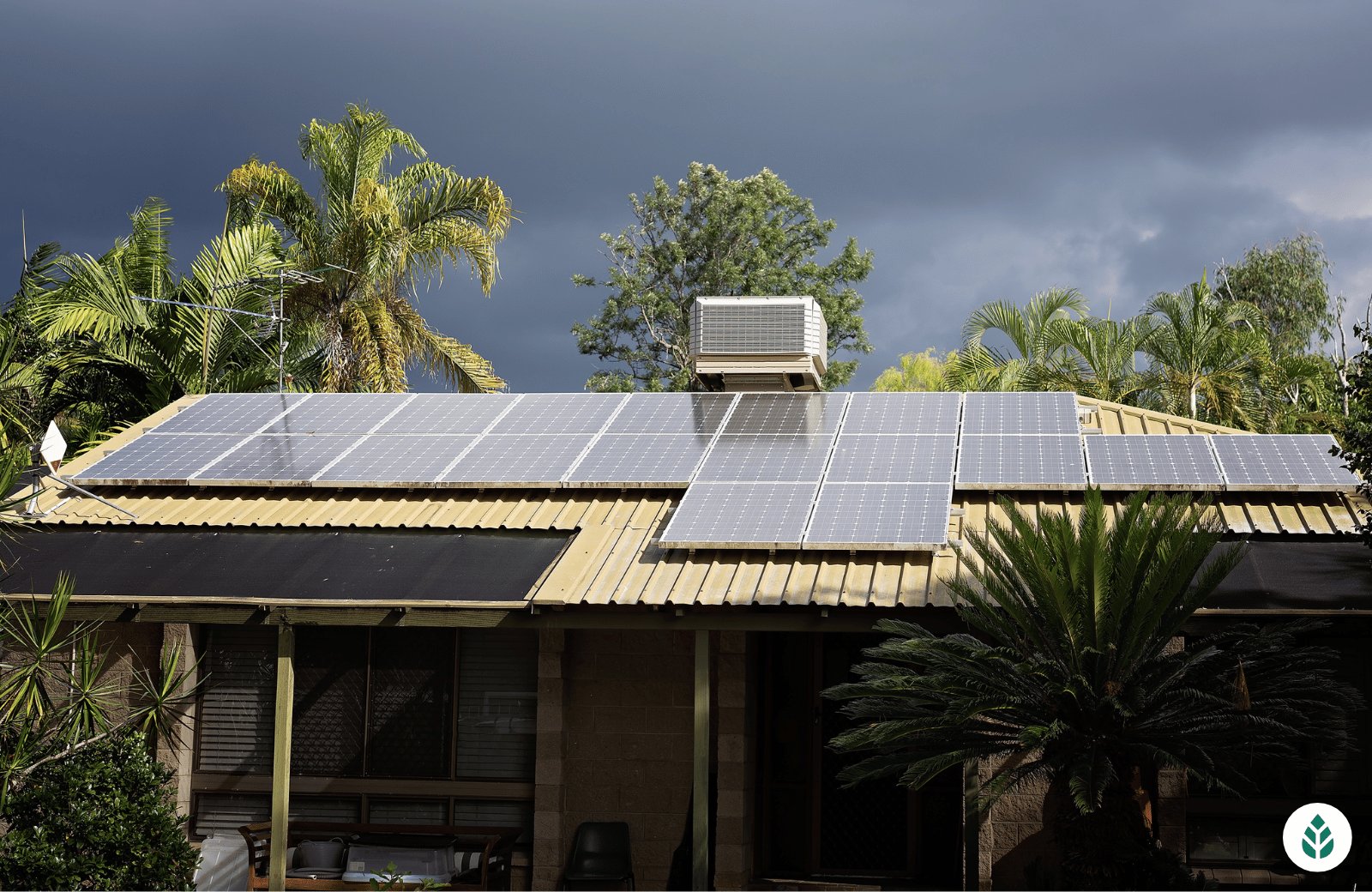
That sounds small until you consider what a roof does in summer. Dark panels in direct sun routinely run 20 to 30 degrees Celsius hotter than the air around them. A 35 degree air temperature can put a module well past 60 degrees, which is more than 35 degrees above its rating, and the output penalty stacks up accordingly.
Run that in reverse for January. Cool air, a module sitting much closer to its rated temperature, and the penalty mostly disappears. The panel is doing its best work in exactly the season people assume it struggles.
What actually drops: daylight and sun angle
Two things change in winter, and both reduce how much energy reaches the roof.
The first is the length of the day. Los Angeles gets a little under ten hours between sunrise and sunset around the winter solstice, against roughly fourteen and a half in late June. Further north it is steeper. Redding loses closer to six hours between its longest and shortest day.
The second is the angle. At the winter solstice the sun at midday sits about 32 degrees above the horizon in Los Angeles, compared with about 79 degrees in June. A low sun means light arrives at a shallow angle to the panel and travels through more atmosphere to get there, so less of it lands and less of what lands is usable.
Shorter day, weaker light. That is the whole winter effect, and it has nothing to do with temperature.
So how much less power, roughly
For a fixed south-facing rooftop array in California, it is common for a December month to produce somewhere in the neighborhood of half what a July month produces. The exact ratio depends on your latitude, your roof pitch, which direction the array faces, and how much of your winter is overcast.
Coastal and inland sites can differ noticeably here. A Central Valley winter brings tule fog that can sit for days. San Diego gets more clear winter sun than almost anywhere in the state. Two identical systems 200 miles apart can have meaningfully different winter shapes with nearly the same annual total.
This is why a credible proposal models a full year rather than scaling up a good month, and why it is worth
comparing quotes on the same basis.
Do they work on cloudy days?
Yes, at reduced output. Panels respond to light, not to direct sunbeams, so an overcast day still produces. How much depends entirely on how thick the cloud is. Thin high cloud might cost you a modest fraction. Heavy winter storm cover can cut production to a small percentage of a clear day.
There is a related effect worth knowing about. Scattered bright cloud can briefly push output above what a clear sky would give, because the panel receives direct light plus light reflected off cloud edges. It is short-lived and it does not offset a genuinely grey week, but it is why production graphs on partly cloudy days look spiky rather than smooth.
What about snow?
For most of California this is not a real question. For the Sierra, the far north, and anywhere above about 4,000 feet, it is.
Snow on a panel blocks production until it clears. Panels are smooth glass mounted at an angle, and they warm slightly from the sun hitting the surface, so light snow often slides off within a day or two on its own. Deep accumulation can sit longer. Steeper roof pitches shed better than shallow ones.
The thing not to do is climb up there with a broom. Scratched glass is permanent, a wet panel array is an electrical system, and a snow-covered roof is one of the more dangerous places a homeowner can stand. Lost production from a few snowed-in days is a smaller cost than a fall.
The number that actually matters is annual
A system
sized to cover your usage is built to overproduce in summer and underproduce in winter. That is the design, not a flaw in it. The surplus you push onto the grid in June is what covers the deficit you pull back in December, and most utility billing for solar customers is structured around a yearly reconciliation rather than a monthly one.
The thing that has changed in California is how much that surplus is worth. Under current net billing rules, energy you export earns considerably less than the retail rate you pay to buy it back. So the old mental model, where a summer kilowatt-hour banks neatly against a winter one, no longer holds cleanly. Timing and self-consumption matter more than they used to, which is a large part of why
batteries now show up in so many California proposals.
None of that makes winter the problem. It makes the shape of your year worth looking at rather than skipping past.
What to ask a quote to show you
If a proposal gives you one annual production figure and nothing else, ask for three things.
The month-by-month production estimate, so you can see what December looks like instead of guessing. The assumed shading losses, since a low winter sun throws much longer shadows from the same tree or chimney and a summer-only shade analysis will miss it. And the tilt and azimuth the model used, because a west-facing array and a south-facing one have very different winter behavior even when their annual totals are close.
A quote that can answer all three has done real modeling. One that cannot has estimated, which is not disqualifying, but you should know which one you are holding before you compare it against anything else.
Winter is also an underrated time to shop. Install calendars are generally less compressed than they are in the summer rush, and you get to evaluate the numbers without a hot roof and a high bill pushing the decision along.
See your quotes in 60 seconds.