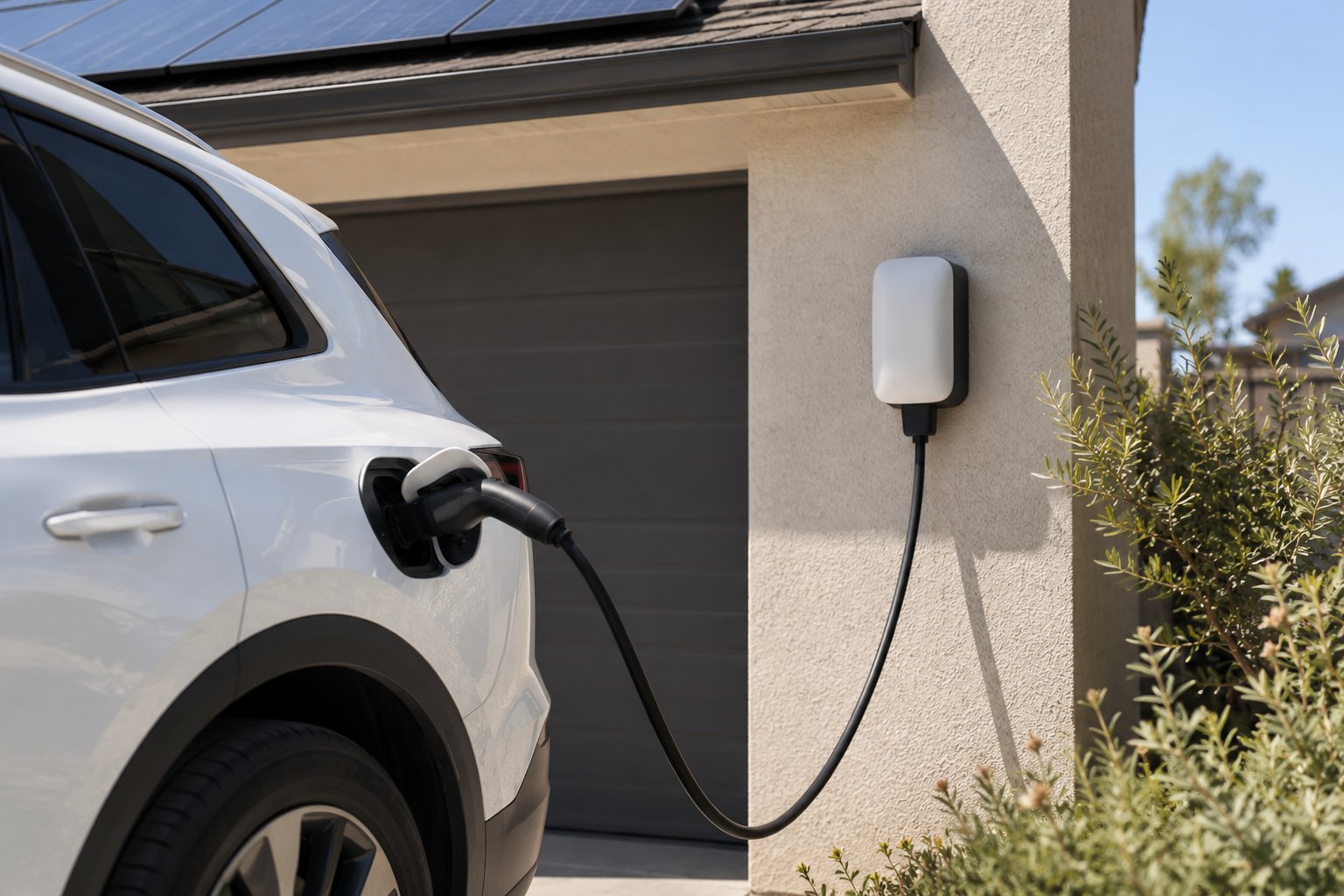
SCE's winter overnight EV rate jumped to 30 cents, above the 24 cent midday window. What changed, why, and what it means if you are weighing solar.
On SCE's EV rate plan this winter, charging your car at 2 a.m. costs more than charging it at 2 p.m.
That is not a typo, and it reverses the single piece of advice every EV owner gets on day one.
SCE's winter overnight rate on TOU-D-PRIME went from 24 cents per kWh last winter to 30 cents this winter, a 25% increase. The cheapest window on the plan is now super off-peak, 8 a.m. to 4 p.m., at 24 cents. Winter rates run October through May, so this is live right now. The catch is that most people are at work with the car during the cheap window, which is exactly the problem rooftop solar and a battery are shaped to solve.
What the rates actually are
TOU-D-PRIME is SCE's plan for households with an EV, a battery, or an electric heat pump. Winter runs October through May. Here is the current structure.
| Super off-peak | 8 a.m. to 4 p.m. | 24¢ |
| Off-peak | 9 p.m. to 8 a.m. | 30¢ |
| Peak | 4 p.m. to 9 p.m. | 45¢ weekdays, 39¢ weekends |
The plan also carries a base services charge of 79 cents a day, roughly $24 a month, and unlike most residential plans it comes with no baseline credit.
Summer, June through September, works differently. There is no super off-peak window at all. Everything outside 4 to 9 p.m. is 26 cents, and peak runs 61 cents on weekdays.
The part that changed
Last winter, overnight on this plan was 24 cents. This winter it is 30. Six cents a kWh does not sound like much until you remember an EV is the largest single appliance most households will ever plug in.
Take a driver putting 333 kWh a month into a car, which is roughly 1,000 miles of typical driving. At last winter's 24 cents that is about $80 of charging. At 30 cents it is about $100. Same car, same miles, same hours, twenty dollars a month more.
That arithmetic uses SCE's published prices and a stated usage assumption. Your own number depends on what you drive and how far.
Why overnight stopped being cheap
For twenty years, overnight was cheap because demand collapsed after midnight and generation did not. Utilities discounted the small hours to keep load on the system.
California broke that pattern by building an enormous amount of solar. In the middle of the day the grid now has more supply than it knows what to do with, which is why SCE created a super off-peak window in the first place and priced it below everything else. Daytime became the surplus.
Overnight, meanwhile, is when that solar is gone and the grid runs on everything else. So the cheap hours moved, and the price followed.
There is a second thing happening underneath. SCE's rates have been climbing across every plan, driven largely by wildfire cost recovery and transmission spending, and that increase lands on each time window at once. Part of the 24 to 30 cent jump is the structural shift. Part of it is just the broader rise.
The problem with the cheap window
Here is the catch, and it is a real one rather than a setup.
The cheapest power on this plan is between 8 a.m. and 4 p.m. Most people with a commute are not home then, and neither is the car. The window that costs the least is the window the average household can least use.
Some people can work with it. If you work from home, drive an EV on errands, or have a second car that stays parked, you can move most of your charging into the cheap block starting today. Changing nothing else, that is worth doing before you consider anything bigger.
If you cannot, the rate structure is telling you something specific. The grid is now paying you, in the form of its lowest price, to consume electricity in the middle of the day. That is a description of what a rooftop array does.
What this means if you are weighing solar
Solar in California has been moving in this direction for a while. NEM 3.0 already moved the value of a system away from selling power back to the grid and toward using what you make yourself. This rate change points the same way from the other side: the utility's own pricing now says daytime power is the cheap stuff.
If you have an EV and a roof, the overlap is hard to ignore. Your array produces in the same window SCE prices lowest, and a car in the driveway during the day is a large and flexible place to put that production.
If the car is gone all day, a battery is what bridges the gap. It stores the midday production and discharges it overnight, which means your car charges on power you generated rather than on 30 cent grid power. That is also what keeps you off the 45 cent peak window between 4 and 9 p.m., when the house is awake and using the most.
None of this means solar automatically makes sense for your house. It depends on your roof, your usage, your financing, and how much of the day your car is actually home. Those are the variables, and they are worth running honestly rather than assuming.
Before you do anything
Two things cost nothing and are worth doing this week.
Check which rate plan you are actually on, because plenty of EV owners are still on a general TOU plan and have never compared. And look at when you charge, because if any of it can move into the 8 a.m. to 4 p.m. block, that is the cheapest change available to you.
After that, the question is whether generating your own daytime power beats buying it, and that comes down to numbers specific to your home.
See what it looks like for your house
Solar Connect sends your project to multiple vetted installers and brings the quotes back in one place, with equipment, financing and battery options laid out side by side. No sales calls, no being handed off, no deciding on anyone else's schedule.
Compare top installers in your area and see how the numbers run for your roof and your car.