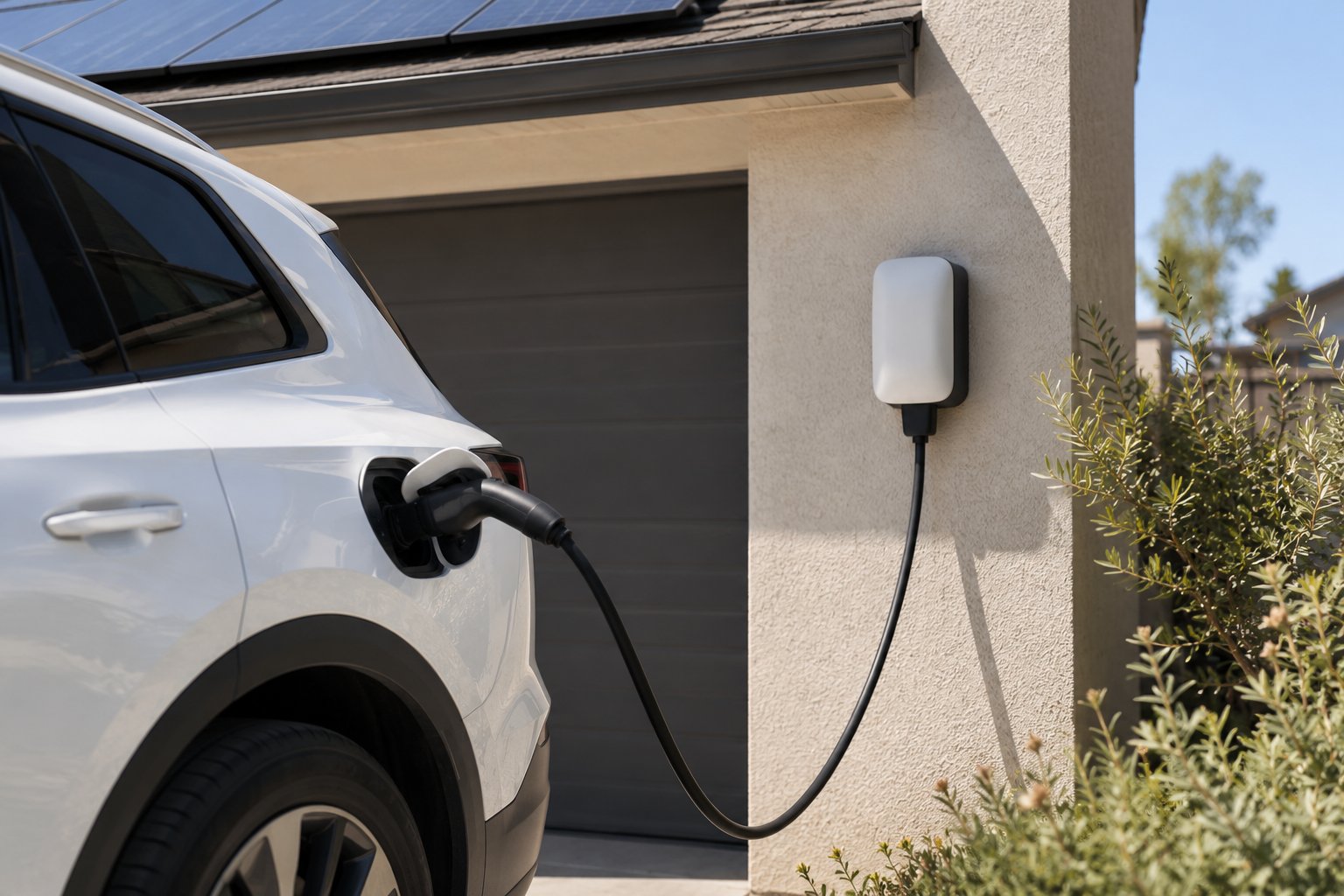
The six best home EV chargers in 2026, compared honestly on output, connector type, smart features, install cost, and warranty. Practical picks for California homeowners planning charger + install through Solar Connect.
The best home EV charger for you depends on three things: your car's connector (Tesla's NACS or J1772), whether you want smart features or a "just works" box, and how far your electrical panel is from where the charger needs to live. Most homeowners land on one of six units. Here's the honest breakdown.
Most homeowners overthink the EV charger and underthink the install. The charger itself is a solved problem. There are six or so units that do the job well, they cost roughly the same to buy, and any of them will get you 25-45 miles of range per hour. The install is where the money and the surprises hide. A short run to a nearby subpanel is one price. A run across the garage to a panel that also needs an upgrade is a very different price.
We'll cover the top six chargers and where each one wins. Then we'll talk about install, because that's the part that actually decides your total bill.
What actually matters when you pick a home EV charger
Ignore marketing language about "future-proofing" and "smart grid integration." Focus on the specs that show up in the invoice:
Max output. Home Level 2 chargers run from 32 to 48 amps (about 7.7 to 11.5 kW). Higher amps mean more range per hour. 40 amps is the sweet spot for most homes. It fills an EV overnight without triggering the electrical work that a 48-amp charger sometimes needs.
Connector type. Tesla vehicles ship with NACS. Most non-Tesla EVs ship with J1772. Some 2025 and 2026 non-Tesla models are switching to NACS natively (Ford, GM, Rivian, Hyundai/Kia). If you drive a Tesla, a native-NACS charger with a J1772 adapter is the cleanest setup. If you drive a J1772 car, you want a J1772 charger natively.
Smart features. Wi-Fi, an app, scheduled charging, load balancing, energy tracking. Useful if you're on a time-of-use utility rate and want to charge only during off-peak hours. Overkill if you plug in every night at 10 pm and don't care about the details.
Install format. Hardwired chargers are permanent and often required for 48-amp units. Plug-in chargers use a NEMA 14-50 outlet, which means you can unplug them and move them. Plug-in is slightly cheaper to install and slightly more flexible. Hardwired is cleaner-looking and rated for higher output.
Warranty. Three to five years is standard. Some go to eight. This matters more than people think. Chargers live outdoors or in unheated garages and get plugged and unplugged thousands of times.
Tesla Wall Connector
Best for: Tesla owners who want the cleanest possible setup.
Native NACS, 48-amp output, hardwired install, Wi-Fi, glass faceplate that looks nice on a garage wall. Includes a J1772 adapter, so it works with non-Tesla cars too. Roughly $475.
The Wall Connector is the default answer for anyone driving a Tesla. It integrates with the car's app, handles OTA updates, and doesn't require a separate account. If you have solar and a Powerwall, it plays nicely with Tesla's energy ecosystem.
The downside: at 48 amps, it needs a 60-amp circuit. That's a real electrical job in a lot of homes. If your panel is tight, you can dial the output back to 40 amps in the app and use a 50-amp circuit instead, which is a much simpler install.
ChargePoint Home Flex
Best for: Homeowners who want smart features and flexibility.
Adjustable 16-50 amps, plug-in (NEMA 14-50) or hardwired, Wi-Fi, a solid app, ENERGY STAR certified. J1772 connector. Roughly $700.
ChargePoint's app is the most polished in the category. Scheduling, energy tracking, off-peak charging, integration with utility rebate programs. If you want a charger that does the smart stuff well, this is it.
The dial-in amperage is genuinely useful. You install it once and can adjust the output later if you upgrade your panel or move to a house with different capacity. Most other chargers lock you to a fixed rating.
Grizzl-E Classic
Best for: Homeowners who want a charger that just works and don't need an app.
40-amp output, hardwired only, no smart features, weatherproof, made in Canada. J1772 connector. Roughly $400.
The Grizzl-E is the workhorse pick. It's a metal box with a plug. It charges your car. It doesn't need Wi-Fi, doesn't have an app, doesn't push firmware updates, doesn't tell you your monthly kWh. If any of that sounds like a feature, buy this one.
Warranty is three years and the reputation for durability is strong. This is what a lot of electricians recommend when the customer says "just give me something reliable."
The Grizzl-E Smart adds Wi-Fi and app control for about $150 more if you change your mind partway through.
Wallbox Pulsar Plus
Best for: Homeowners with tight garage space who want smart features.
40 or 48 amps depending on the version, hardwired, one of the smallest chargers on the market (about 7 x 7 x 4 inches), Wi-Fi, Bluetooth, decent app. J1772 or NACS versions available. Roughly $650.
If your garage is already full and you want a charger that disappears into a corner, the Wallbox is the pick. It's roughly the size of a router. The mounting bracket is well-designed and installers like working with it.
The Wallbox also handles solar integration cleanly if you have or are planning to add rooftop solar. It can prioritize charging from excess solar production, which is useful under NEM 3.0 in California where exported power gets paid at a low rate.
Enphase IQ EV Charger
Best for: Homeowners with existing Enphase solar or battery systems.
40 or 48-amp variants, hardwired, integrates natively with the Enphase app if you already have Enphase microinverters or IQ Batteries. J1772 or NACS. Roughly $700-$800.
If you already have Enphase gear, this is the obvious pick. Everything shows up in one app: solar production, battery state, EV charging session. Enphase's home energy management can route excess solar to the car automatically.
If you don't have Enphase solar, this charger is fine but not obviously better than the ChargePoint or Wallbox. Buy it for the integration or skip it.
Autel MaxiCharger AC Wallbox
Best for: Homeowners who want a full smart charger at a lower price than ChargePoint.
40 or 50 amps, hardwired or plug-in, Wi-Fi, Bluetooth, RFID authentication, big color display, five-year warranty. J1772 or NACS. Roughly $500-$600.
Autel is a newer entrant that's been picking up recommendations from installers. The build quality is solid, the app is fine (not as polished as ChargePoint but improving), and the five-year warranty is longer than most competitors. The RFID feature is useful if you share the charger with tenants or roommates and want per-user tracking.
Hardwired vs plug-in: the install decision
This is where a lot of homeowners get stuck. The short version:
Plug-in (NEMA 14-50): Cheaper up-front install ($300-$600 typical if the electrical run is short), portable, works for chargers up to 40 amps. Requires a GFCI-protected outlet in most 2025+ code jurisdictions, which adds cost.
Hardwired: More expensive up-front ($500-$1200 for a typical run), permanent, works at any output including 48 amps, cleaner appearance, no GFCI outlet required (the charger itself handles GFCI).
Most 40-amp installs come out roughly the same total price whether you go plug-in or hardwired once you factor in the outlet cost. Above 40 amps, hardwired is the practical choice.
How to actually price out the install
The install cost varies more than the charger cost. Two houses one street apart can have wildly different quotes based on:
- Panel capacity (a 100-amp panel with everything already loaded might need an upgrade)
- Distance from panel to charger location
- Whether you need trenching or conduit runs through finished walls
- Whether the panel is inside or outside, and how easy it is to add a new breaker
- Local permit and inspection fees
A tight, short run to a nearby panel can be $500. A run across a finished garage to a full 100-amp panel that needs upgrading to 200 amps can push $4,000. Same charger, same house on paper, very different price.
The way to get honest pricing is to get quotes from multiple electricians who all look at your specific setup. Guessing from an internet cost calculator is how homeowners get surprised at the end.
Solar Connect handles the EV charger side of this by bundling the charger and the install into one quote per installer. You submit your setup once (address, EV model, panel details if you have them), and licensed electricians on the platform quote both the hardware and the labor together. You compare finished prices side by side instead of piecing together a charger from Amazon and an electrician quote separately.
Bottom line
If you drive a Tesla, buy the Wall Connector.
If you don't drive a Tesla and want the smartest charger, buy the ChargePoint Home Flex.
If you don't care about smart features and want to spend the least, buy the Grizzl-E.
If your garage is tight or you're integrating with solar, buy the Wallbox Pulsar Plus (or Enphase IQ if you already run Enphase).
If you want most of the ChargePoint's features at a lower price with a longer warranty, buy the Autel.
The charger itself is the easy decision. Spend the mental energy on the install, because that's where the total price is decided.
Compare EV charger + install quotes from licensed California electricians in 60 seconds at
Solar Connect.